
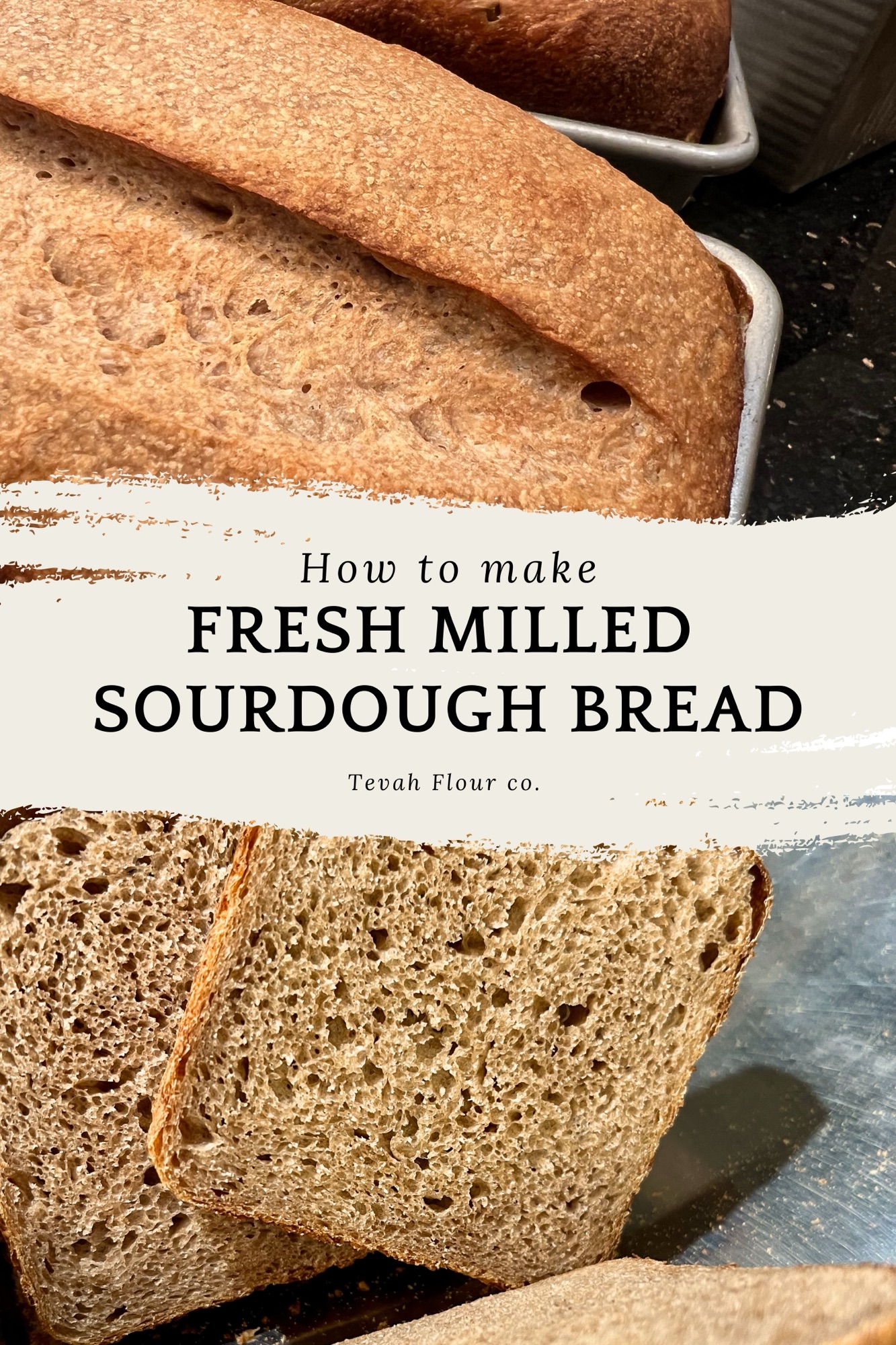
This sourdough is an achievement for me — the result of years spent learning how fresh-milled flour really behaves and how to work with it instead of against it.
It isn’t white sourdough, and it doesn’t pretend to be. Fresh-milled dough is softer, more delicate, and often happier with the support of a loaf pan. What it gives back is a beautifully soft crumb, deep flavour, and bread that feels genuinely nourishing.
This is the kind of sourdough that feels rooted and traditional — the kind people baked long before tall, dramatic loaves became the standard. It’s simple, exciting in a quiet way, and deeply satisfying to make.
🍞 Tevah Base 100% Fresh-Milled Sourdough
Recommended with lightly sifted Bread Mix, Hard Red, or Hard White flour.
Yields: about 2 × 800 g loaves + 500 g extra (for rolls or pizza) OR 3 × 700 g loaves
Fermentation: 4–6 hrs bulk | Overnight cold proof (or same-day option)
Flour Options
Use Bread, Hard Red, or Hard White flour:
- Bread Flour – (My personal blend of Red Fife, Hard Red, and Hard White flour) rich and hearty with heritage grains.
- Hard Red – full-bodied, nutty flavour.
- Hard White – mild and neutral, letting the sourdough tang shine.
Fresh-milled flour ferments faster than white — watch proof times!
Ingredients
- 1000 g fresh-milled flour
- 600 g water (start here; add up to 50 g more if needed for a soft, stretchy dough)
- 325 g active, bubbly sourdough starter
- 20 g kosher salt
- 20 g organic sugar or honey
- 40 g organic olive oil
Method
- Autolyse – Mix half the flour and half the water until just combined. Cover and rest a few hours or overnight. This allows the flour to hydrate and begin developing structure.
- Mix & Knead – Add remaining ingredients and mix 10–15 minutes (or by hand) until smooth and elastic. The dough should feel strong yet supple — slightly tacky but not sticky.
- Bulk Ferment – Transfer to a lightly oiled bowl. Stretch and fold every 30 minutes × 4, then coil-fold hourly until nearly doubled (4–6 hrs total).
- Divide & Shape – Make two 800 g loaves plus one 500 g portion (great for rolls or pizza), or three 700 g loaves. Shape into greased pans and rest 1–2 hours, until puffed and airy.
- Once active, refrigerate overnight for best flavour and crumb.
- In a hurry? Let rise fully and bake the same day.
- If under-proofed by morning, warm briefly on the counter before baking.
- Bake – Score if desired. Bake covered for 30 minutes at 375–425 °F (190–220 °C), then uncover for 15 minutes more. The internal temperature should reach 204–205 °F (95 °C).
- Cool – Remove from pans and cool completely before slicing to preserve crumb texture.
🌤 Notes
- Cooler, slower fermentation creates deeper, more complex flavour.
- Start with lower hydration until you’re comfortable handling fresh-milled dough.
- Extra dough makes excellent rolls, braids, or flatbread.
“Give us this day our daily bread.” — Matthew 6:11


Leave a Reply