
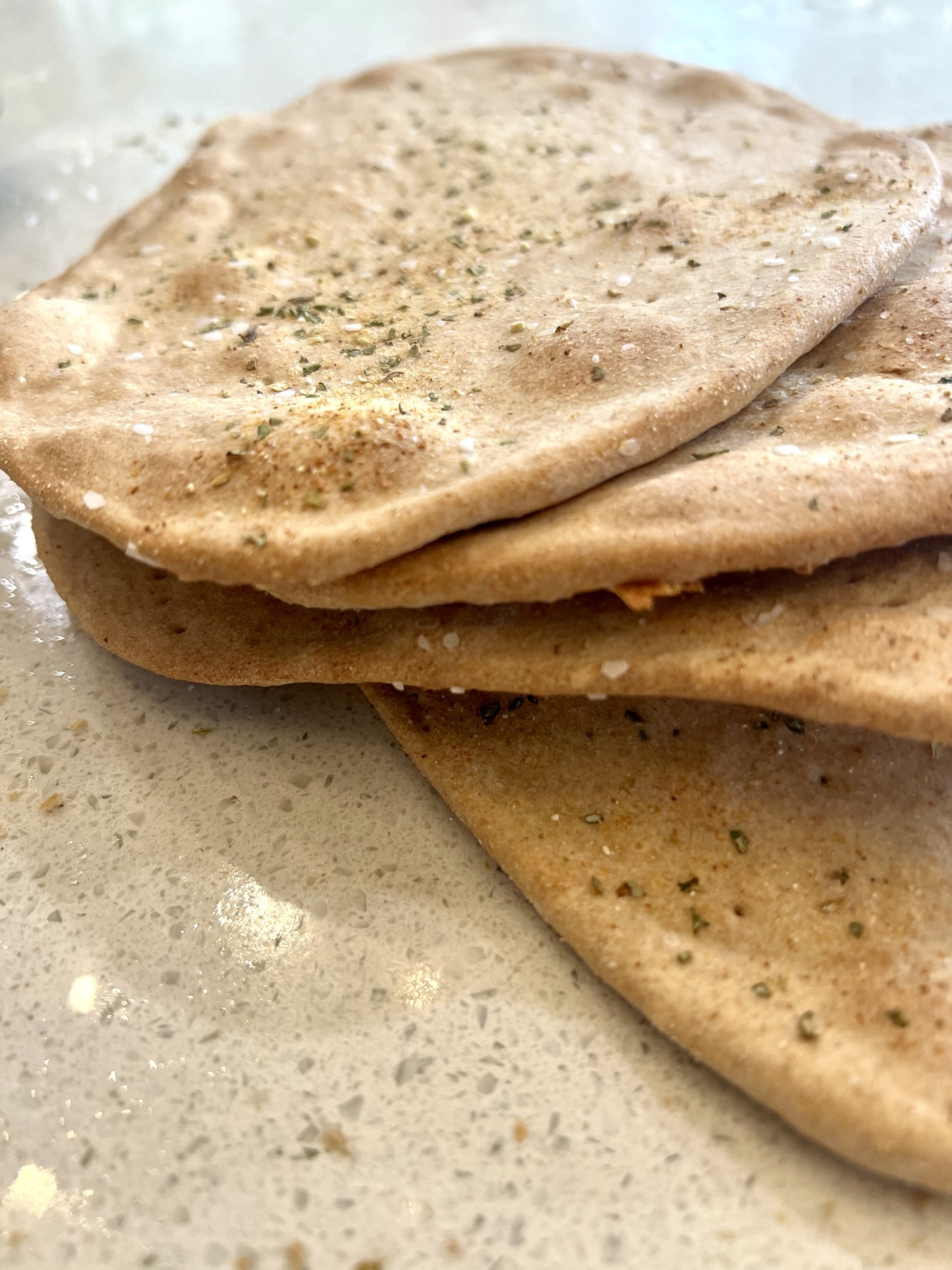
Every year, as believers, it is our family tradition to participate in a Passover remembrance that begins the week of unleavened bread in springtime. It is something that we all look forward to and that is really meaningful to us. So I wanted to share my personal recipe for unleavened bread. It is tried and true, a family favourite, and also works really well for bringing to gatherings as we feast with our friends and families during this season.
I just wanted to share a little of why this is meaningful to us. If you are just here for the recipe, feel free to skip down to the bottom.
Scripture let’s us know that the week of unleavened bread is something tied to remembrance and to a set-apart week. Deuteronomy says, “for seven days you shall eat unleavened bread with it, even the bread of affliction; for you came out of the land of Egypt in haste; that you may remember the day when you came out of the land of Egypt all the days of your life.”
Since the kids were little we started this tradition. We go through the house and get rid of the leavening, and it feels powerful.
It is such a simple, physical thing, but it carries so much meaning. A lot of people think of leavening as just meaning sin, and that can be part of it, but it feels bigger than that too. Scripture talks about things that spread, things that work their way through quietly and affect more than we realize. Paul talks about malice and wickedness, and elsewhere there is the warning about hypocrisy too. It is that idea of something spreading through everything, something that can become unhealthy and toxic if left alone. So going through the house to purge out the leavening feels like a chance to stop and reflect. To look honestly at our lives. To ask what has been spreading in us that should not be there.
As Paul says in 1 Corinthians 5:7–8:
Purge out the old yeast, that you may be a new lump, even as you are unleavened. For indeed Christ, our Passover, has been sacrificed in our place. Therefore let’s keep the feast, not with old yeast, neither with the yeast of malice and wickedness, but with the unleavened bread of sincerity and truth.
The whole family, including the kids, really enjoy this week because it feels special, and different than the ordinary. Honestly, without planning, it can be a bit of a challenge because we are so used to eating toast and sandwiches through the day, so it breaks up our usual patterns and makes us think outside the box a little bit, which does not always feel super comfortable, but I think that is kind of the point.
Overall, though, we have figured out a pretty good pattern. I bake unleavened bread every couple of days so there is always some on hand, and the kids can use it for little sandwiches, snacks, or just eat it fresh. It is something they really look forward to every spring, and honestly, because it is intentionally made fast, it’s actually really quick and easy to whip up.

I also really love making it with fresh-milled flour because unleavened bread on its own can honestly be a little boring. Fresh-milled flour gives it so much more flavour and makes it feel hearty and good and worth eating.
After playing around with it a lot, spelt is my favourite.
It just works so well here. It can make a really beautiful crispy cracker if that is what you want, especially if you roll it thin and bake it a bit longer. But if you bake it a little less, it gives a soft texture that is not overly chewy, which I really like. Some of the harder wheats need more time to absorb water and soften properly, and that kind of diminishes the whole point of unleavened bread. This is supposed to be made quickly. Hurried. Mixed, rolled, and baked without a long rest.
Exodus says:
This is how you shall eat it: with your belt on your waist, your shoes on your feet, and your staff in your hand; and you shall eat it in haste. It is Yahweh’s Passover.
That is part of why grains like spelt and einkorn can be so helpful here. They absorb water more quickly and do not need the same kind of resting time that some harder wheats do. My all-purpose baking blend works really well too. But if I am picking one grain to feature for this, it is spelt.
I also just love that spelt is there in Scripture too. Ezekiel 4:9 mentions it specifically among the grains used for bread: “Take for yourself also wheat, barley, beans, lentils, millet, and spelt, and put them in one vessel. Make bread of it.” There is just something special about using a grain with that kind of history. An ancient grain, used for bread, still being milled and baked with now. It feels rooted. It feels really neat.
And the recipe itself is simple, which is exactly why I like it. It comes together in just a few minutes, which is the whole point.

Fresh-Milled Spelt Unleavened Bread
Ingredients
- 600 g fresh-milled spelt flour
- 2 tablespoons honey
- 2 tablespoons kosher salt
- 1 tablespoon olive oil
- 1½ cups water
- Flaky kosher salt, for sprinkling on top
Half Batch
- 300 g fresh-milled spelt flour
- 1 tablespoon honey
- 1 tablespoon kosher salt
- 1½ teaspoons olive oil
- ¾ cup water
- Flaky kosher salt, for sprinkling on top
Method
Preheat your oven to 350°F.
Mix the flour, honey, kosher salt, olive oil, and water together until a dough forms. Knead for about 3 to 5 minutes. In the mixer, this is pretty easy, and then I usually put it on the counter and knead it just a little bit more by hand.
Cut it into sections depending on how big you want to make your matzo pieces, then roll them out flat on the counter. You can use a bit of oil or butter if needed. The dough should not be too sticky. It should roll fairly easily and peel off the counter pretty well, kind of like a tortilla.
Sprinkle with flaky kosher salt, poke all over with a fork, and get it into the oven fairly quickly.
For a soft, flexible bread, bake for about 7 to 8 minutes.
For a crispier cracker-style version, roll it thinner and bake it a little longer. You can also raise the oven temperature slightly if you want more crispness.
You can also mix in Italian herbs or a garlic blend, which we really like. If I use toppings, I like to lightly roll them into the dough so they stay on better after baking.
And that is really it. Very simple. Very quick. Very meaningful. It breaks up our normal patterns for a little while each spring, and I think that is part of why it stays with us. It makes space to reflect, to remember, and to do something a little more intentional together as a family. Over time, it has become one of those traditions that we all genuinely look forward to, and I think that is part of what makes it so special.

Leave a Reply