
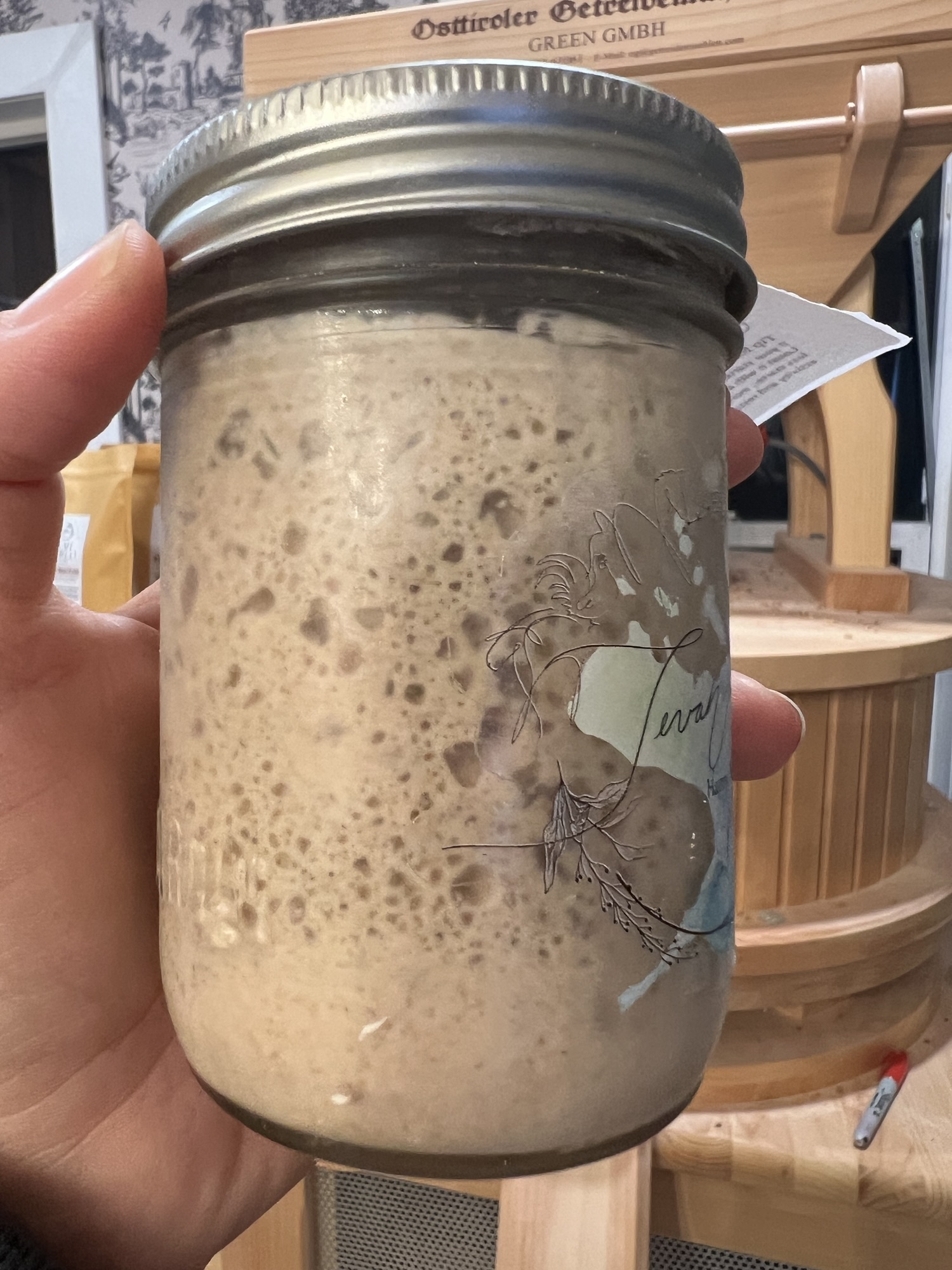
If you’re new to sourdough, welcome! Sourdough comes with a surprising amount of its own language, but caring for a starter really doesn’t need to be complicated.
This guide will walk you through activating your Tevah Flour Co. freeze-dried sourdough starter, feeding it, storing it, and understanding what it’s telling you along the way.
Don’t have a starter yet? You can shop our Tevah Flour Co. freeze-dried sourdough starter here.

Quick Links
- Activate Your Starter
- Why Freeze-Dried?
- Understanding Feeding Ratios
- Learn to Read Your Starter
- Fridge Storage & Waking It Up
- What Is Discard?
- Troubleshooting
- When Is It Ready to Bake With?
Quick Start: Activating Your Sourdough Starter
Step 1: Rehydrate
Add approximately 1 tablespoon of freeze-dried starter to a clean jar with 1 tablespoon of lukewarm water. Stir and let sit for about 10–15 minutes.
You do not have to use the entire pouch. Seal up whatever is left and keep it dry as a backup. You can also use the whole pouch if you’d rather.
Step 2: Give It Its First Feed
Once you’ve rehydrated it, that mixture is now your starter. You do not add any more freeze-dried starter.
Add approximately 1 tablespoon of flour and 1 tablespoon of water and mix well. It may be a little runny at first, and that’s okay.
Step 3: Keep Feeding
For the next 3–4 feeds, feed your starter approximately every 12 hours.
You may start seeing bubbles surprisingly quickly. Once it’s active and bubbly, you can begin giving it larger feeds, such as a 1:3:3 ratio.
Step 4: Watch for Doubling
Put a rubber band around your jar at the level of the starter immediately after feeding. When your starter is reliably rising and roughly doubling in volume after feeding, you’re getting close to baking.
Your Tevah Flour Co. starter will often be ready to bake with within 2–3 days, although temperature and feeding schedule can change the timing.
Why Freeze-Dried Sourdough Starter?
One of my favourite things about this starter is that you’re not starting a sourdough culture from scratch. You’re waking one back up.
Unlike traditionally dehydrated starters, ours is freeze-dried. I’ve used both, and it’s one of the reasons I chose this method. Our established culture wakes back up remarkably quickly once you add water and fresh flour.
You’ll often begin seeing activity very quickly, and our starter is typically active and ready to bake with within 2–3 days. No spending a week or more trying to establish a brand-new culture from flour and water.
And once you start feeding it fresh-milled flour, don’t be surprised if it moves fast!
What Does 1:1:1 Actually Mean?
Sourdough feeding ratios are simply starter : flour : water, measured by weight.
So a 1:1:1 feed could be:
- 10 g starter + 10 g flour + 10 g water
- 20 g starter + 20 g flour + 20 g water
A 1:3:3 feed gives your starter more food:
- 10 g starter + 30 g flour + 30 g water
- 20 g starter + 60 g flour + 60 g water
A larger feed takes longer for your starter to work through. If it’s peaking and collapsing very quickly, give it more food rather than assuming something is wrong.
And don’t get too hung up on perfect ratios. I prefer my starter a little thicker. If yours is very runny, use a little less water at the next feed. If it’s difficult to stir, add a little more.
Watch the starter in front of you. That’s much more useful than trying to make sourdough obey an exact clock.
Learn to Read Your Starter
Just Fed
Thicker and relatively quiet. Mark the level on the jar so you can watch it grow.
Active and Growing
Bubbles begin appearing throughout the starter and its volume increases.
At Its Peak
Your starter has reached its highest point and looks bubbly and airy. This is a great time to use it for baking.
Past Its Peak
The starter begins falling again. That’s normal. It’s simply running out of food. If this happens very quickly after feeding, try a larger feed next time.
Fresh-milled flour can make a wonderfully active starter. A 1:1:1 feed may sometimes peak within only a few hours, particularly in a warm kitchen.
If you’re keeping your starter on the counter, feed it regularly. If you don’t want to maintain it every day, pop it in the fridge.
Keeping Your Starter in the Fridge
You absolutely do not have to keep your starter on the counter and feed it every day.
Once it’s healthy and active, give it a good feed and let it rise. I like to put mine into the fridge at or near its peak, when it’s bubbly, active and well fed.
The cold slows everything down until you’re ready to bake again.
Waking It Back Up
You don’t need to wake up the entire jar. Take a small amount, even a teaspoon or two, and put it into a clean jar.
- Give it a generous feed.
- Let it become active and rise.
- Feed it again.
- Once it’s rising strongly and predictably, build the amount you need for baking.
My own rhythm is usually a generous feed the first night, another feed the following morning, and then I build my levain that evening.
What Is Discard?
“Discard” sounds much more dramatic than it is.
If you continually fed your entire starter without removing any, the amount would grow and grow, and so would the amount of flour needed to feed it.
Discarding simply means keeping a smaller amount of starter before feeding it again.
You don’t have to throw established discard in the garbage. Use it in pancakes, crackers, muffins or other discard recipes. And if you maintain a small starter, you’ll create very little discard in the first place.
Sourdough Starter Troubleshooting
My starter is really runny.
Use a little more flour or less water at the next feed. I prefer mine smooth and stirrable but noticeably thick.
It rises and collapses really quickly.
It’s probably working through its food quickly. Try a larger feed, such as 1:3:3.
It isn’t rising very much.
If you’ve just rehydrated it, keep up with the regular feeds and give it time. If an established starter is sluggish, take a small amount and give it a generous fresh feed. A cold kitchen can also slow things considerably.
It smells really sharp or acidic.
It’s probably hungry. Give a small amount a larger fresh feed. A little fresh-milled rye can also give a sluggish starter a great boost.
I forgot to feed it.
Sourdough is surprisingly resilient. If it still looks and smells like normal sourdough starter, take a small amount, put it into a clean jar and give it a good feed.
There’s liquid on top.
That’s likely hooch, a sign your starter has been sitting hungry. Pour it off and give your starter a good refresh.
I see fuzzy mould or unusual coloured growth.
This is different from hooch or normal separation. Discard the starter and begin again. If you saved some freeze-dried starter from your pouch, this is exactly why that little backup is handy.
Can I use different flour?
Yes. A healthy starter is adaptable. Fresh-milled wheat works beautifully, and I especially love adding a little fresh-milled rye when a starter needs a boost.
When Is My Starter Ready to Bake With?
You’re looking for a starter that:
- Rises predictably after feeding
- At least doubles in volume
- Has bubbles throughout
- Looks airy and active
- Smells pleasantly fermented
- Can hold its peak before slowly beginning to fall
Once you’re seeing those signs consistently, you’re ready to bake.
Feed the Starter in Front of You
If there’s one thing I want you to take away from this guide, it’s this: watch your starter more than you watch the clock.
Too runny? Use less water. Hungry too quickly? Give it a bigger feed. Kitchen cold? Give it more time. Not baking for a while? Put it in the fridge.
The goal isn’t a starter that follows a perfect schedule. The goal is one that’s strong, active and predictable.
Once you learn what that looks like, sourdough gets a whole lot simpler.
Want to Go a Little Deeper?
If your starter is alive and bubbly but your bread still isn’t behaving the way you expect, I’ve written more about starter strength, thicker feeds, seasonal changes and resetting a tired starter in Why Most Sourdough Issues Start With the Starter.
Ready to Start Your Own?
If you don’t already have a starter, you don’t have to build one from scratch. Our Tevah Flour Co. freeze-dried sourdough starter starts with our established fresh-milled culture and is quick and easy to activate in your own kitchen.
Shop the Tevah Flour Co. Sourdough Starter →
Happy baking!
Leave a Reply